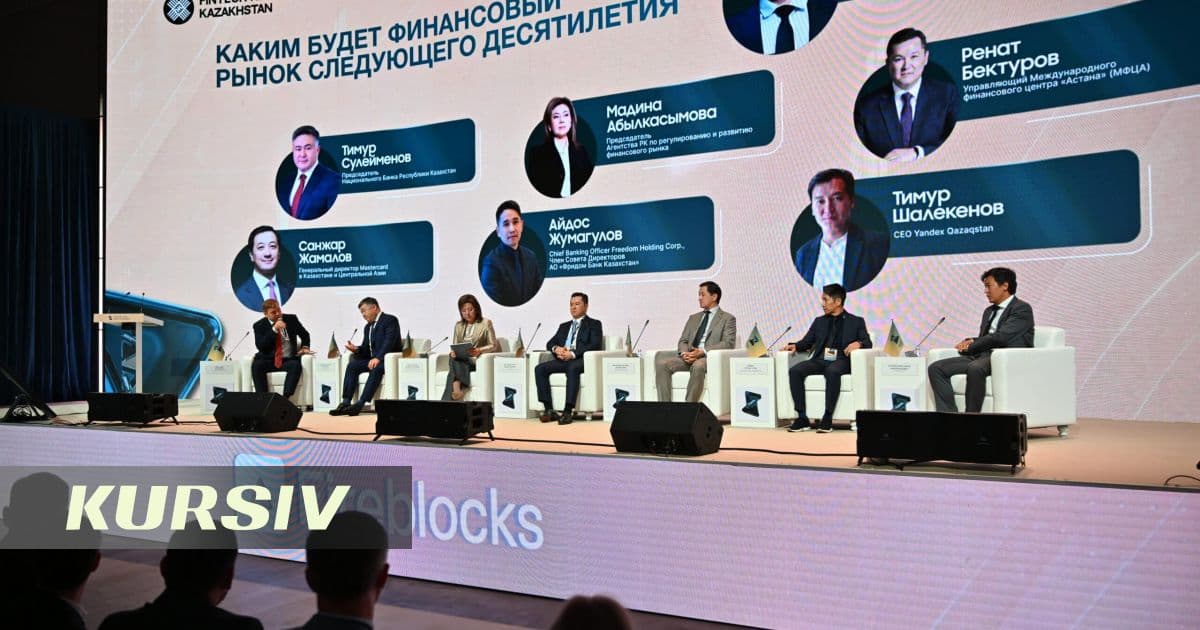
By September 1, 2026, the National Antifraud Center helped block fraudulent transactions worth 127 billion tenge. Currently, more than 270 participants are connected to the system, as reported at the Central Asia Fintech Summit 2026 in Almaty. At the summit it was noted that the Antifraud Center has become one of the main elements of the national digital financial infrastructure along with interbank payments, digital tenge and biometric identification. The results of the system’s work were summed up at the National Antifraud Awards 2026 ceremony. Digital tenge remains another area of development of financial infrastructure. In 2026-2027, the volume of transactions with it is expected to reach 2 trillion tenge. In addition, more than ten solutions based on artificial intelligence are already in commercial operation at the National Bank. The development of the digital asset market continues. 34 projects are currently being implemented in the regulatory sandbox, and $700 million has been allocated to the National Crypto Reserve. The results of the Fintech Stars Battle competition were also summed up at the summit. The main winner was the SHART RATE project, a digital platform for concluding legally binding online contracts. The startup received the opportunity to raise up to $100 thousand from White Hill Capital under the SAFE contract. The influencer marketing platform BEHYPE, led by Aigerim Beisembina, received a place in the acceleration program in Dubai from Tumar Innovation Hub. The BYTRADER startup, which is developing a trading terminal with artificial intelligence and risk management tools, received a grant of 6 million tenge from Yandex Cloud. General Director of Kazakhstan Fintech Network Dias Savetkanov noted that the competition should give startups direct access to capital and industry expertise. As part of the Central Asia Fintech Summit, we also signed memorandums with Tether and VEON on the development of joint projects in the technological and financial markets of Kazakhstan. A separate agreement was concluded by the National Payment Corporation of Kazakhstan and the payment system of Uzbekistan HUMO. The parties intend to ensure mutual acquiring of national QR codes: residents of Uzbekistan will be able to pay for goods and services in Kazakhstan through the Kazakh national QR, and Kazakhstanis will be able to use the UzQR system in Uzbekistan. In addition, it is planned to develop transfers between users of the two countries through familiar banking applications. Chairman of the Board of the National Payment Corporation Zhanar Samaeva said that the partnership should ensure the compatibility of the national payment infrastructures of the two countries. The head of HUMO, Alexander Sotnikov, called the project a step in the development of cross-border payments in the region. Earlier, Kursiv wrote that about 20 million payments have already been made through a single QR in Kazakhstan. Deputy Chairman of the National Bank Binur Zhalenov noted that 99.5% of operations were successful, and the transition of retail outlets to compatible QR codes is planned to be completed in about six months. Kursiv also reported that from October 2026, Kazakhstan will begin issuing licenses to payment organizations of the first category. They will be able to issue cards by opening
The anti-fraud center of Kazakhstan blocked transactions worth 127 billion tenge
By September 1, 2026, the National Antifraud Center helped block fraudulent transactions worth 127 billion tenge. Currently, more than 270 participants are connected to the system, as reported at the Central Asia Fintech Summit 2026 in Almaty. At the summit it was noted that the Anti-Fraud Center became one of...
AI Summary & Key Takeaways
- By September 1, 2026, the National Antifraud Center helped block fraudulent transactions worth 127 billion tenge
- Currently, more than 270 participants are connected to the system, as reported at the Central Asia Fintech Summit 2026 in Almaty
- At the summit it was noted that the Anti-Fraud Center became one of...
Related stories
Teradyne Robotics partners with Sereact to scale physical AI in retail and logistics
At Zalando’s fulfillment centers in Germany and Poland, Sereact and Universal Robots now autonomously processes returned fashion items. | Source: Teradyne Robotics Teradyne Robotics, the company behind Universal Robots and Mobile Industrial Robots, last week partnered with…
Artificial intelligence robot Grok has learned to independently recover from falls
The artificial intelligence robot Grok has learned to recover independently from falls. An unusual demonstration of a robot running under the control of the Grok Brain Engine system was shown online. The car is pushed hard, it falls to the floor, but almost instantly it starts...
Microsoft says its AI diagnoses complex diseases more than twice as accurately as doctors. Co...
Microsoft says its AI diagnoses complex diseases more than twice as accurately as doctors. The company is preparing to create a medical superintelligence. A study published in the journal Science showed that the Microsoft MAI-DxO system correctly identified…
The creator of Twitter presented an AI that speaks almost like a living person
🎙 The creator of Twitter presented an AI that speaks almost like a real person. Jack Dorsey's Block company introduced Dessa, a new voice AI model capable of maintaining natural dialogue without the usual delays. The main feature is that Dessa was trained exclusively in…